If you’re like me and grew up in the ‘90s and early 2000s, then you may be familiar with a boy wizard by the name of Harry Potter. Rowling’s epic saga detailing out the seven years of Hogwarts School of Witchcraft and Wizardry for young Potter captured the imaginations of both young and old alike. Eight movies followed suit (with the last book broken out into two movies), and even now, we still hear about the wizarding world in both film and gaming. I personally got into the series after seeing the first two movies, which like bait on a hook, reeled me into the books.
The mixture of modern day settings with fantastical creatures and magic not only make for good stories, but in the right hands, can reinvigorate a child-like wonder in its readers. We saw this with Harry Potter at the height of its popularity. In fact, we still see this with Harry Potter. Did you know Quidditch is now an actual competitive sport? If you don’t believe me, check out the US Quidditch website and see the kind of influence that fiction can have on people.
There’s so much more to urban fantasy than just Harry Potter. One of th reasons I think this genre of story is so popular, is because many of us are ingrained with tales of modern magic from a young age. Ever hear of a jolly old fat man in red using magical reindeer to deliver presents? What about a giant egg wielding bunny rabbit that delivers candy and hides plastic eggs? And don’t get me started on that creepy fairy that sneaks into the bedrooms of children to steal teeth from under their pillows. What is her problem?
But what makes for a good urban fantasy tale? As with any story, having the three elements of story-telling down is a must. Plot, setting, and characters. Without those, there is nothing to tell. With urban fantasy though, we have a fourth story element to keep track of, the “fantastical” element. This element is what puts the “fantasy” in urban fantasy. What’s involved with managing this mystical fourth element? I think it can be boiled down into two simple questions: what are the rules of the magical element? What is society’s perception of magic?
There Are Rules
Whether we like it or not, rules rule our lives. Many exist for a reason. They exist either to protect us, or to ensure we don’t walk all over each other. In literature, rules serve a much different purpose. With the magical element of urban fantasy, rules are less about safety and more about consistency.
As limiting as it sounds, the rules of the world you create are a lot like a cage for which the characters and plot fit into. When done correctly, the cage is more than big enough to accommodate all the characters, their needs, and still have plenty of breathing room left over. Now on one hand, this sounds limiting. After all, don’t cages, by their own definition, trap us? Not in this case.
Limiting ourselves forces us to think outside the box. One rule involving magic that is often seen: use of magic incurs a physical toll on the user’s body. This effect limits our characters as it caps their magic to prevent them from spraying spells like a tommy gun. This also opens up a wealth of possibilities in the narrative. If a character is running from the law, they’ll want to use magic to aide in their escape. But, they can’t over do it, or they may pass out from exhaustion. So what do they do? This further complicates the character’s situation if they are attempting to save a life. While use of the cage may at first sound limiting, you can see how it just opened up several doors for us to explore.
One must carefully weigh the rules they use in writing urban fantasy. Like with cages, it’s easy to go too far and place our characters in a place that doesn’t even let them stretch out their arms. We need to approach our rules with care. When done correctly, that cage will turn into a paradise that will lock in not only us writers, but our readers as well.
Perception
The other question to answer: what is society’s perception of magic; will help to shape not only the characters, but the overall plot as well. With this question, there are three primary possibilities to consider: society is not aware of magic, society is aware and accepting, and, society is aware but is not accepting. Each of the three options allow for a plethora of stories to be told.
If considering a tale where humans are unaware of the magical elements, then the story may lean towards Harry Potter or the Stone Blood series of books. In both of these book series, the human world and the magical world are somewhat separate. Unlike Harry Potter where the wizarding world stays grounded with elements such as cauldrons and flying broomsticks, the Stone Blood series takes a different approach. Vampires roam through night clubs, consuming illegal forms of blood (similar to drug addicts with narcotics, only more violent). Meetings are scheduled with iPads for royalty, while their magic keeps the darkness at bay. The Stone Blood series by Jayne Faith merges the human technology a bit more with the Faerie realm. One element that these two series share is how their plot mainly revolves around their magic based realms more-so than the non-magic ones. Harry and Petra both spend time in the human world, but the main plot points occur in their magical based worlds.
In the Grimnoir Chronicles by Larry Correia however, society is very much aware of the existence of magical beings. However, due to the time period in which the book takes place, there is still some prejudice against the magically inclined. This allows for some fascinating scene construction and character interactions. I can vividly remember the beginning of the book, Hard Magic, and how a young girl was traded off to a farmer who recognized her as having special abilities. The scene shows both the unease some people had towards her (like her own parents and siblings), while also showcasing people who cared regardless (such as the farmer). Such freedom allows the plot to travel in all manner of directions. In this particular case, the main conflict is that of a super weapon capable of destroying entire cities. The story could have easily just focused on the girl growing up, and it would’ve still been an excellent read.
Push Hard Magic in the right direction, and you end up with our final option: the magically inclined are hated by society. This option sits a bit more special with me, as the novel I’m currently working on, falls into this category. What I’ve learned in this world, is that the human hatred for magic tends to play a major role in the plot of the story. For not only does my story occupy this chair, but it shares the seat with a beta-read I did for someone.
An entire group of people being hated/persecuted (be it for physical characteristic or having the “wrong” set of beliefs) is nothing new in the real world. Unfortunately, there are plenty of examples to pull from for inspiration. What this allows for though, is a tale that can both feel so far away, yet hit so close to home at the same time.
With the story I’m working on, magicals are synonymous with evil. They are the root of all crime, and there are few who would argue against the purging of them from society. It’s reflected in the culture through books that are published, and television shows that air. A deafening wave of anti-magical propaganda corrupts any innocence that may try to slip through the cracks. This places the human hatred of magicals at the center of the story. The main characters constantly deal with its affects, and must find a way to not only survive, but open the eyes of others to make the world livable.
Such atrocities in fiction can lead to both depressing, and uplifting tales. The depressing nature comes from the story’s setting and the types of pain inflicted on the magical community. Even the story I beta read, I found myself both shocked and amazed at the dark world the author had constructed. Even in that tale though, the characters being hunted found laughter, and had hope for a better future. This is where we can see people pull themselves out of the dark, and into a brighter future.
Wrapping Things Up
No matter which variation of urban fantasy one prefers, or what kind of creatures inhabit the lands, there’s a special kind of magic that these tales bring to life. Some may opt for a darker, gritty look into the world, while others have more of a spring in their step. It’s a genre full of possibilities, just so long as everyone plays by the rules.
Trivia time! Name the series that this famous tagline is associated with: “You better beware. You’re in for a scare!” Figure it out? Yes, this tagline was prominently associated with R.L. Stine’s famous series of books, the Goosebumps books. I can distinctly remember those words being uttered during the opening of the TV series of the same name. Both the television series and the book series played a large role in my childhood. Over the years, I amassed a collection of over sixty of the original Goosebumps books. Some of the stories still stick with me, even after all these years.
Choose Your Adventure
One particular subset of Goosebumps books fascinated me more than any other. Those books were known as the “Give Yourself Goosebumps” series. In these books, the story was told from the second person point of view, and allowed the reader to determine how the story would play out. How did this work? Simple. The reader would start by reading through the first two or three chapters for some setup. The third chapter would end with a choice for the reader to make. At the bottom of the page, instructions would indicate which chapter to read next based on the reader’s decision. This pattern would continue with branching paths until the reader either escaped the nightmare they’d found themselves in, or would meet an untimely demise with any manner of monsters or crazed trappings.
I can remember spending countless hours rereading through these books to find all the endings. Taking a different path each time to see what would happen, and what new creature I’d stumble upon. The books, rather simple in structure, had just the right amount of novelty to keep me coming back time and again to see what kind of adventure I could go on.
Looking back on the “Give Yourself Goosebumps” series, they were quite silly. Many times the main character would make decisions that I personally found to be stupid. I wished I could have had a say in certain decisions that would occur mid-chapter. Other times, the main character’s attitude towards his/her friends made me want to smack him. There’s also a finite number of things the author can do with this type of main character. Because the reader has control over the protagonist, the author has to be careful in how they are fleshed out. Give too much personality and the reader may become alienated from someone that is supposed to represent the reader. It is definitely a balancing act.
What draws me to this kind of writing though is the uniqueness of it. Whether writing a short story, a novel, or even a screenplay, the flow of the story is always the same. It starts with Chapter 1 and moves on to Chapter 2 and so forth (or from Scene 1 to Scene 2 etc.). In the “Give Yourself Goosebumps” books, the reader may go from Chapter 3 to Chapter 15, and then to Chapter 9. It’s a genre of storytelling that I think requires a completely different kind of mindset. It’s one I’d be curious to explore. But it’s not just books where we see this, it occurs in many forms of media.
Interactive Movies
Probably the rarest breed of interactive story-telling is the interactive movie. In fact, off the top of my head, I can only provide two examples of this genre of film. Those two films are: Final Destination 3, and Return to House On Haunted Hill. Both are horror movies, and both are far from being any good (though Final Destination has its charm). To experience the interactivity of these movies, one needs to own the DVD/Blu-ray versions of them.
How does one interact with a movie? Simple. At certain points in the movie, the scene will pause and give the view the option to (in these cases) watch the characters die, or let them live to see another day. This is gimmicky at best, and hardly worth going out and buying either of these movies, but it does create replay value for those interested. It also adds work for the filmmakers as, in order to make this possible, extra scenes need to be filmed. Now, I haven’t experienced either of these movies in all their “interactive glory” for some time, but it does raise some interesting questions. How does one account for all the possible combinations of choices in their script? How is the story merged back together?
With the given examples, most of the characters in slasher movies tend to be expendable. Thus, I’d estimate the impact on the story would be minimal at best . It makes for a fun ride, but aside from switching out some character deaths, you’re probably not making a whole lot of difference.
Into the gaming sphere
Speaking of interactive stories, how about them video games? Come on, it was inevitable we’d wind up in this category. Video games are the absolute masters at interactive story-telling. Just ask anyone that’s played through the likes of Final Fantasy, Legend of Zelda, or Mass Effect. There is a wealth of games that we could discuss, and pick apart in terms of literary quality. But first, let’s explore a more niche genre of games that is entirely story based.
Visual novels. Okay, don’t run for the hills just yet. Yes, there are a bevy of terrible visual novels notorious for their forced romantic plots, anime-esque aesthetics (and I’m not trying to say the anime look is bad), and even adult oriented content. But, if one sets aside the trash and instead takes an honest look at visual novels as a potential literary medium, I think one will be surprised at the potential.
Visual novels can get upward of 500,000 words in length, some even closing in on a million words. Now that’s a hefty stack of papers! Trying dusting off the old typewriter for one of those projects. But why so long? Like the Give Yourself Goosebumps series, visual novels expand upon the chapter skipping mechanics and takes it to next level. Think of it like a set of vines growing along a wall. They may all sprout from the same location, but they can weave back and forth, crisscrossing along their paths to the other side.
Visual novels are much like this. You’ll start at a common location, and read sometimes chapters worth of content, before coming to a choice that needs to be made. Music, imagery, and sometimes voiced lines help to set the stage. Upon making a decision, you’re led down a different path that will eventually intersect with a common series of events that all paths share. Sometimes the detour is short-lived, and only fits a scene or two worth of content. Other times though, that branching path will have its own set of decisions that need to be made before coming back to the common path.
Visual novels can have upwards of eight or nine endings, all being completely different. They generally stick with a core cast of characters, including the reader. What makes visual novels special is just how character driven they are. Interactions with the various characters is what propels the story, and leads the reader down various paths. Imagine writing a crime novel where the reader gets to interview different suspects, and based on descriptions along with dialog, try to determine who they can trust, where they can search for clues, and how they can prevent the next murder.
The stereotypical visual novel is a badly written, anime girl infested romance story that rewards the player at every turn. That species of visual novel has its place, but when one looks at the core mechanics of the visual novel, I think it exposes something far more special and worthy of our attention. It gives us a whole new avenue to explore with how we tell stories and interact with our readers.
It’s dangerous to go alone! Take this.
Finally, how about a quick look at a more traditional set of games? Games like The Legend of Zelda, Skyrim, and Final Fantasy. Video games, for all their problems and bad press, have the ability to open up a whole new world of story-telling. Now lets get one thing straight. Not all video games are capable of telling a competent story. Some don’t even try (nor should they).
One of the things that draws people to video games is the story that players can interact with, and be a part of (with limits of course). Think about it. Say you’re writing a book and there’s a scene where a man goes to a convenience store to buy bread. The interaction with the man and store clerk may just be a one off, and the clerk is never seen again. Or, a conversation could ensue where that gives the reader a sense of the world the clerk lives in. Maybe he’s poor and this is his second job. There’s a lot that can happen between the main character and that clerk.
In a video game, there can be far more interactions between the player and that same clerk. The player could choose to run an errand for the clerk, and as a result, learn more about the clerk’s life. The player could visit the store frequently, and learn something new about the clerk each time. Or conversely, the player could vandalize the store and run the clerk out of town. It’s all dependent on how the game is coded of course, but what makes video games unique is that this clerk doesn’t even need to be involved with the main story.
The ability for a player to interact with characters on a whim, is what sets video games apart from books. The main story will exist for the player to fight the bad guy and save the day (or sometimes do the opposite), but there may also be a plethora of characters populating the world that can be interacted with, and that have their own story to experience. At this point, one isn’t just writing a book, one is writing a living, breathing world, and populating it.
Now I know what you’re probably thinking. I’m overselling the hell out these video games! And you may be right. With our clerk example, they’ll be plenty of players that never bother to talk to the guy. Not only that, but many games don’t include that level of detail, and once the next game comes out, the ones that do may just get forgotten anyway.
What draws me to the world of writing in video games though, is the stories inside of stories that one can tell. The overarching story of the game may be that an evil sorcerer has kidnapped a princess, but on an individual level, there could be hundreds of tales waiting to be told. Some may be directly related with the main plot, while others may be as simple as helping a lone farmer come up with the finances needed to save his farm. It’s the culmination of experiences in these games that tell the bigger story of the world it’s set in. Sure, some players won’t care and just want goodies they get from doing a mission, but for those that do care, it can make for a far richer experience.
The Winding Roads
What fascinates me about writing are the many ways in which we can tell stories. Sometimes, it’s the books and screenplays we write that connect with people Other times, it’s the more unique and niche experiences that really stick. Whether it’s sitting down in bed with an Amy Cross novel, or having my eyes glued to the TV while playing Ocarina of Time or Resident Evil 0, it’s the experience with the characters and the stories they tell that will always bring me back for more. While we all have our preferences in how and what we write, we should always embrace new ways to reach our readers. There’s a thousand winding roads just waiting for exploration.
Have you ever held something fragile in your hands, like a porcelain doll or a crystal ball? Then dropped it. Watched it shatter against the ground into a million pieces. If you have, then I would imagine your initial response to the catastrophe would much resemble John Candy’s when he smashed a piece of fine china against a piano in the classic comedy, Uncle Buck. For those who haven’t had the pleasure of seeing this hilarious movie, his reaction was exactly what you’re imagining right now. It involves the utterance of a four letter “s” word, along with the frustrated swing of an arm.
A mistake. An understatement if there ever was one (especially if that fine piece of china was a priceless antique), “dropping the ball” perfectly describes my handling of this little blog. Between some busyness in my life, laziness, and other events, I unfortunately left this blog laying in pieces scattered across the floor. Somehow, I need to pick up the broken glass without cutting myself, and find a way to move forward. It’s not an easy thing to do, but let’s see what ideas can be had.
Do you know why I pulled you over?
When I started this blog, my goal was to keep it focused on writing. After all, my goal is to become a published author. It’s been a dream of mine since I was a kid. The news on this front, is mixed, but positive. First, the good news: I have a complete draft of my manuscript! If that wasn’t enough of good news, I’d also like to add: I’ve had two beta readers take a swing at the novel. While one still has three or four chapters to finish up, I have received positive feedback from both of them. Obviously, there is plenty of work to be done with the myriad of suggestions they’ve provided. But, the consensus between them is that the backbone of the story is solid.
The bad news on this front is that instead of hitting the pedal to the metal, I’ve eased up on the gas, and pressed down on the brakes. My momentum has slowed on the project to a crawl. Now in some ways, that is not a bad thing. Listening to other authors, after they finish their first draft, they set it aside for a few weeks/months before coming back for revisions so that they have a clear head. No argument here. But, my writing as a whole has slowed, not just on this specific novel.
Okay, what’s the problem?
At this point, I feel like I’m in that comfy looking sofa you always see in a therapist’s office where people lie down and spew out their problems. I don’t however, want to just spew out problems, without offering a few solutions. Because let’s face it, countless aspiring writers find themselves in this exact predicament. I’ve got a manuscript. I’ve got feedback. Now what?
Idea #1 Don’t Stop Writing!
Remember the first post I made here? What was it called? Oh yeah, “Just Write!” I think I may need to return to that post and give it another read. It’s very important to not break the flow of writing. After finishing my first draft, there certainly was a void in me. Mainly, I’d reached the end of the road for my draft, with nowhere else to go. A celebration was in order, as finishing a manuscript is kind of a big deal. But after that, where to?
There’s a couple of paths one could take (least that I’m seeing). One path being: if the story you’re writing is left open for a sequel, why not start working on it? It’s the perfect opportunity to flesh out characters, where their paths may lead them, or how to expand upon the world. My novel is one where I have it wide open for a sequel, and I do have notes started for a follow-up. Progress has just slowed. This is one option for me, and any others that find themselves in this same situation.
Another idea (whether it’s because you won’t be doing a sequel, or you want a break from that world you created) is to start something fresh. It doesn’t necessarily have to be another novel. It could be a short story, a poem, or even a blog post! Find some writing competitions or anthologies accepting submissions, and try to submit something. Get your name out there, and get more eyes on your work (even if that means rejections). I think here is where one can find a variety of sources for motivation to keep themselves going if they’re feeling a bit lost.
Finally, and I do think this is an important one (as contradictory as it may initially seem), is to find something other than writing to occupy your time and head-space. This sounds quite counter-productive to everything I’ve written. After all, wasn’t I just discussing how I’d “dropped the ball” on this whole blog? Well yeah, but at the same time, as writers, we don’t want to burn ourselves out on writing. Believe it or not, it’s good to step out into the real world from time to time.
For instance, I just recently built myself a new computer. How exciting is that! Well it’s very exciting, and very scary as it turns out. I was briefly worried I’d done something wrong when I couldn’t power the thing on in a test bench setup (basically meaning I was running the computer outside of the case). Fortunately, after connecting the power button from the case to the motherboard, I got the thing running and was able to resume with the work.
My point is, building that computer took time and energy. I needed to find a case, a motherboard, a CPU, a graphics card (took several summoning rituals for this one), and several other components. Then one Saturday later, I had myself a brand new computer. The time I put towards this project allowed me to focus on something other than writing. And in order to continue to write, we also need to be able to step away from our writing and do other things. It’s a balance, one I need to improve with.
With all that said, of course one still needs to return to that completed draft and eventually begin on the editing phase. Using a kanban board, note cards, or whatever works for you, to organize the issues that needs addressing will help in conquering your editing mountain.
Need more ideas?
If you are looking to step into a different world and need a place to start, there’s a few recommendations I would like to make. While I won’t retread old ground, I’ll briefly mention a couple of ideas here that people can use (including myself) to get themselves started on a writing project (or take an existing one into a new direction).
The first idea is: writing prompts. These come in many shapes and sizes. From character generators to basic story concepts, generators can be used to quickly provide topics for struggling writers to use as jumping-off points. They also make for great exercises in forcing you to think on your feet, and push your imagination into a specific direction. I remember participating in a writing panel a few years back at an anime convention. We were given an object, and had the duration of the panel to write a short fan-fiction using anime characters that somehow revolved around the given object. I remember taking almost the whole panel just to build a story around the given constraints. Over half of our time limit had passed before I even put pen to paper. I did manage to finish my little piece before the buzzer. Though I never saw that little story again, it was an experience I’ll never forget.
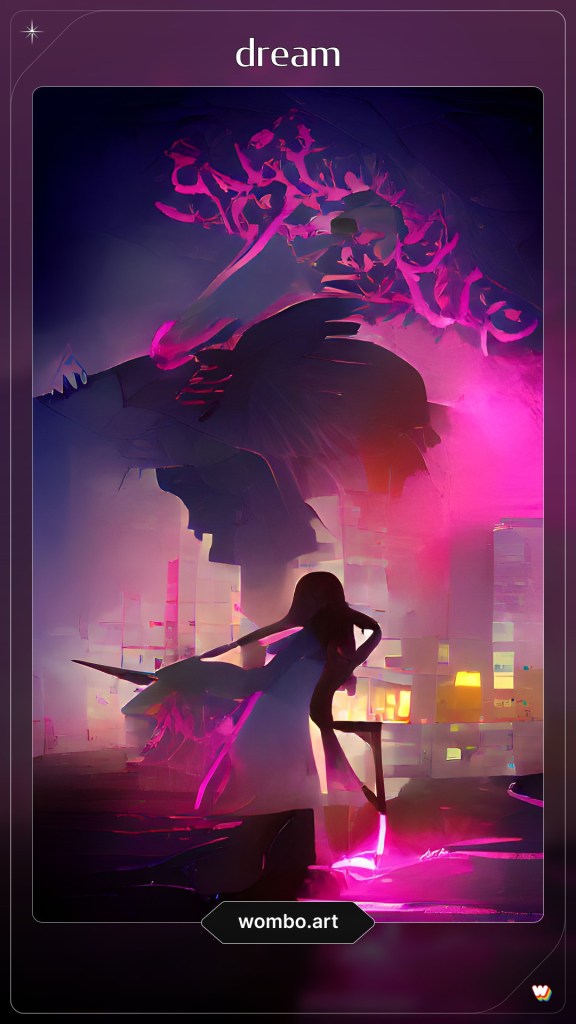
The other idea (and this I ran across more recently) is using an image generator to randomly generate images based off some keywords. Recently, a friend shared a website with me: https://app.wombo.art where you provide it with as many keywords as are allowed. You then specify a style of art, and click on the Create button. What happens next is almost magical. An image is generated through what I assume to be some form of AI. You may get some garbled gunk of a picture, or something that is truly inspiring. Regenerate the image as many times as you want, choose a different style, and when you’re satisfied, save the creation.
Generated Wombo Art
Results may vary. But just look at this image above that I was able to generate simply by specifying the following words: silhouette, girl, weapon, city, breath, and hell. It’s a mesmerizing picture that with a little creative thought, one could put together an action packed, edge of your seat tale. I’ve experimented with this site numerous times. It’s actually quite addicting. And it’s something I intend to play with in the future, and who knows, maybe could even lead to a full on novel someday.
Where things go from here?
From here, I need to work out how I should organize my time with projects. I of course want to continue my work on this blog. I have a few ideas for topics that I can write about. I just need to revisit what I already have noted down (along with discovering new topics). And if you have any ideas for things you’d like me to write about, please comment below.
I may occasionally post short stories here for everyone to enjoy. Perhaps I could start using the website listed above to generate some images and build stories out of those. Take that brain to the gym for some heavy lifting, so to speak.
All in all though, I hope that sharing some of my struggles, and some different solutions prove helpful to not only me, but some of you out there. Hopefully the next time we meet, it’s not another six months down the line. I don’t want to be shattering anymore plates.
Quick poll! How many of you have ever bought a bookshelf or table from an online retailer, and then had to assemble it once the giant box finally arrived? Yes? Follow-up question, did said bookshelf or table come with cheap alan wrenches or screwdrivers that couldn’t properly tighten a bolt if your life depended on it? Yes? Then you can appreciate the value in what having the right tool for the job can do for a person. Once in a while, the pack-ins will be of tolerable quality. But for me, I’d rather just pull out my own set and do the job with tools I know actually work.
Much like furniture assembly, there is a plethora of tools available to writers. These tools each have their own specialties, and like those cheap alan wrenches and screwdrivers, some tools are better than others.
I wanted to cover writing tools early, because I wanted to discuss the tools that I currently use, and mention a few that I don’t. Then someday in the distant future, maybe I’ll revisit this topic and see how much my tool-set has evolved over time. Also, I’d love to hear about any of the tools that you use when writing, or even just planning out writing projects.
Microsoft Word
Probably the most common tool that a writer uses is a word processor. After all, how else are you going to pen the next Nebula winner? You could use a notebook and pencil to write out your story. Or if you really wanted to go old-school, grab a typewriter and go to town that way! In our modern age of technology, those options are more than a little antiquated. Nowadays, many places ask for digital submissions with particular formatting guidelines. The most efficient way to meet these guidelines is with the use of a word processor, where a couple of clicks will give you exactly what they need.
Word processors come in all shapes and sizes. The most recognizable one being: Microsoft Word. I’ve been using Microsoft Word for years to note out my stories, to copy down research from various websites, and to draft out chapters. It’s been my go-to piece of software for years. I can’t count how many pages worth of documents I’ve built up in Word alone!
That said, Microsoft Word isn’t the only option. Libre Office is a free alternative to the Microsoft office suite. It includes its own versions of Word, Excel, and other office programs. While there is some compatibility between Microsoft Word and Libre Office’s equivalent, it’s not perfect and I wouldn’t recommend going back and forth between the two. That said, Libre Office is a viable option for those looking for a cheaper(free) alternative to Microsoft Office.
While we’re on the subject of word processors, when I’ve needed a quick editor for tossing down some notes, I’ve used NotePad++. Now, you may ask: what is NotePad++? It’s a free alternative to the built in NotePad program on Windows machines. NotePad++ is more geared towards software developers, as it provides helpful features for dealing with HTML, JSON, and XML (things that I would imagine writers have zero interest in). That said, NotePad++ is quite customizable and I have mine setup with a dark mode on it. For quick notes, it’s a handy little program when one doesn’t require all the bulk of a full-on word processor.
Microsoft Excel
My personal writing calendar (Yikes! Too many zeros!)
Keeping in the vein of Microsoft Office tools, Microsoft Excel is one of my most valuable tools (or really any spreadsheet software could be inserted here). What could I possibly use Excel for? It’s my accountability application. I use a custom Excel spreadsheet to track the number of words that I write in a day. I break it down by month, and by year to help me track my progress. As you can see in the included image, there’s far more zeroes on this spreadsheet than I care to admit to.
With that said, this spreadsheet helps keep me on task. With having used this method of accountability for as long as I have, it’s drilled into my head the importance of keeping up with my writing. For as many zeroes as appears in this spreadsheet, I never enjoy entering them. Instead, I get a nice boost of confidence whenever I can enter a word count that surpasses my daily goal of 500 words. On top of that, when a monthly total surpasses multiple previous months, that only adds fuel to my writing fire.
One thing I’ve read from various articles is that being held accountable makes a difference. If you have someone to report your progress to, you’re far more likely to work on your craft so that when you do meet with that person, you can show them said progress. I experienced this first-hand as a software developer when I worked with a friend overseas to develop a simple mobile video game. I’d always wanted to create a video game, but never got up the motivation to do it. When she started working with me though, I knew that if I didn’t make progress on our game, she would be upset. That alone motivated me to do my part, and after months of working together, we managed to push the game out onto the Google Play Store.
With my writing, I don’t have such a person to hold me accountable. I have this Excel spreadsheet instead. While my failures are on full display, so are my successes. And because of what this spreadsheet has drilled into me, I’m currently within four chapters of having completed a full draft of what will hopefully be my first novel.
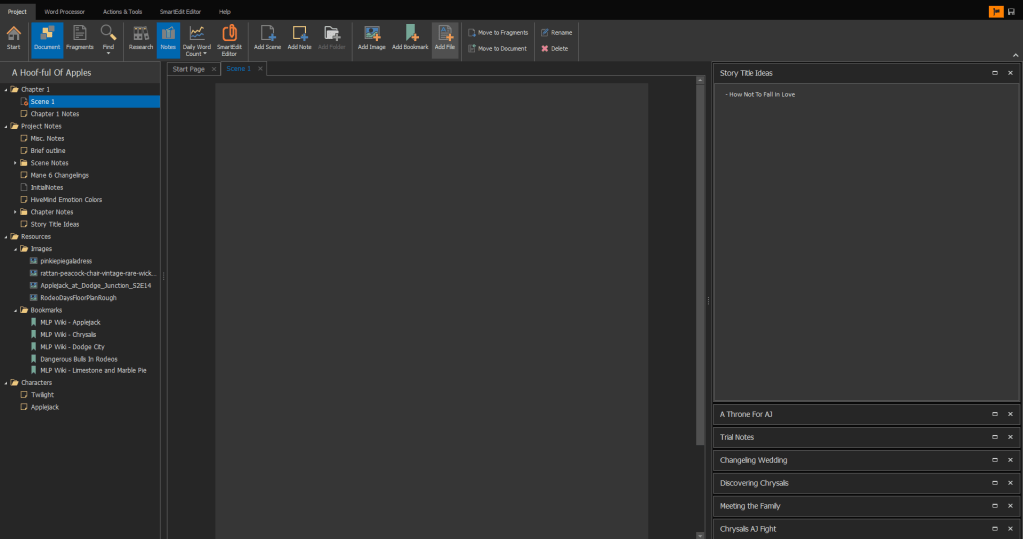
An old fan-fic project of mine in SmartEdit Writer. As you can see, it’s a bit on the empty side of things.
Remember when I said I used Microsoft Word for a great deal of my writing? Well I wasn’t being completely honest when I said that. While it is very true that I’ve used Microsoft Word for my writing in the past (holding hundreds of thousands of words worth of writing no doubt), I’ve since drifted away from the software and to something far more writer-oriented. I learned about SmartEdit Writer from a local author whom I’d had the pleasure of meeting a couple years back. He’d told me of the free software, and how it was more tailored to a writer’s needs. He encouraged me to try it out. Being stubborn in my ways, it took me a long time to break away from my Microsoft Word habits and move fully into SmartEdit Writer.
SmartEdit Writer is so much more than a word processor. It allows you to organize your novel/memoir/short story/etc. into a project. You can add things such as: notes, bookmarks, images; and then organize them into folders. It also allows you to break your story down by scenes, and then also provides a tool for exporting your work (a feature I haven’t tried as of yet). While I haven’t exhaustively tested out all of the program’s features, what I have worked with, I’ve been quite pleased with. With Word, I’d have two or sometimes three separate documents open, and I’d have to flip between them to work on my writing. With SmartEdit Writer, everything is quickly accessible in one place. If you’ve used the Microsoft suite before, then SmartEdit Writer will feel very familiar as it has a very “office-y” vibe to it.
If you’re looking for something different to try with your writing, I’d recommend giving SmartEdit Writer a go.
iTunes/Music
This next one may seem a bit confusing. Why would iTunes be listed as a writer’s tool? It’s just a piece of software for playing and organizing music! Exactly! This plays more to my style of writing, so it may not be for everyone. When I work on a story, I like to find a song that matches the tone of my story, and could even be considered the “theme song” for my story. Then, when working on notes or chapters for said story, I like to listen to the song on repeat to help with inspiration (or even a mood setter) for whatever I’m working on.
With the novel I’m working on now, my song of choice is a song by James Durbin: Everything Burns. Now, take a guess as to how many plays this song has on my iTunes so far? I’ll wait. Beep! Time’s up! If you guessed 2,008 plays, you’re correct! And by the way, that number is only going to go up. The story isn’t done yet!
I wasn’t kidding when I said I listened to the song on repeat while writing. Of course, I realize that this may not be a tool for everyone. If music isn’t your thing, maybe there’s something else that gets those words flying onto the page. It’s all about putting yourself in the right frame of mind. For me, music is what helps me get into that “happy place.” (Happy Gilmore anyone?)
Perhaps in a future blog post, I’ll dig a bit deeper into inspiration and what inspiration looks like for me. For now though, lets move onto something we’re all a bit familiar with.
WordPress
WordPress! This is the newest tool in my toolbox that I’m still trying to learn. While I’ve had an account with WordPress for quite some time, I never actually did anything with it. I decided to start writing on WordPress to: help further my reach with people, engage with a community of writers/readers, and learn more about myself as a writer.
Writing can be an isolating hobby/career. One person in front of a computer, typing away until their fingers wear down to bone. Okay, so that’s a bit of an exaggeration, but it still hits the nail on the head. When I’m writing, be it fan fiction, fiction, or blog posts like this one, I’m not talking to anyone or working in a group. I’m just sitting in front of my computer and typing away. Don’t get me wrong, I love to write and I’m not much of a social butterfly anyways. I’m actually quite the opposite. But it is important to belong to a community for both encouragement and critique.
As cliched as it sounds, working together and helping each other lets everyone grow as writers and as individuals. By helping to further my reach, I’m hoping to meet like-minded people, and even some not so like-minded people. I’m hoping to become part of a writing community and decided that WordPress would be a great place to start. And who knows where I’ll be a year from now? But I have to admit, I’m looking forward to finding out!
Thesaurus/Dictionary
Now let’s hit up some of the more basic tools in not just my toolbox, but everyone’s toolbox. And how more basic can we get than to bring up dictionaries and thesauruses? I won’t spend much time on these tools as we’re all familiar with them, and I’m sure we’ve all used them at one point or another.
My main experience with dictionaries, with regards to writing (mainly using Google for looking up words versus the hard covered Webster dictionary at this point), is when while writing, I use a word I don’t quite know the definition of. So why’d I use the word in the first place? Simple! I used it because it felt like the right thing to do. The dictionary lookup is more of a confirmation. Nine times out of ten, my instinct ends up being correct.
The more useful tool though, is the thesaurus. Again, I mainly use an online thesaurus. My main use case with pulling out the thesaurus from my toolbox, is when I’m searching for a particular word to articulate what I want to convey to the reader. Usually it’s a word that I know, but somehow escapes me. Other times, I’m not satisfied with how I phrased a particular description and so I go searching for something better. In the past, I’ve used dedicated thesaurus software, but now, an online search is more than enough for me.
As a computer programmer, one of the phrases I constantly hear at work is: “naming is hard.” And it is! It’s extraordinarily difficult to name properties and variables in code that accurately reflect what they are for. Sometimes, it’s easy. If I have a program that adds two numbers together, the answer can be called the “sum.” But, if a couple hundred lines of code returns a value, how does one describe the value being stored? That’s when naming gets difficult.
Similar to programming, I’ve found that naming characters, cities, and fictional companies (and whatever else you can think of) can be just as difficult. How does one approach such a daunting task? Should actual company and city names be parodied or should something completely original be brought into existence? Honestly, I don’t have a good answer for that question (and I think it depends on the piece). For naming characters, I have at least settled upon an approach that has worked out for me so far.
Baby name websites! There are a plethora of websites dedicated to baby names. The intended use of said sites are to provide a resource for parents who are expecting a child. The sites tend to break names down by gender, and then sorts them alphabetically. One can also search names by country of origin, or even meaning. It’s these last two filters that I use most often. I’ll use country of origin as a way to provide a certain level of consistency with the names, or to help with naming a foreign or more exotic character. As for the name’s meaning, I like to use names where the meaning of the name reflects a certain trait of the character.
Even with the baby name sites, naming is a difficult task. With some stories, sometimes I know the names that I want right away. With others, I need a bit more soul searching, and that’s where these websites come into play. As for company names and city names (and whatever else you can think of), I’ve read that one should list out 15-20 possible names for their entity in question. And only after the eighth or ninth name does actual contenders for the throne start to appear. Is it perfect? No. Is it for everyone? Certainly not! But it is another strategy I have used and found helpful when brainstorming names.
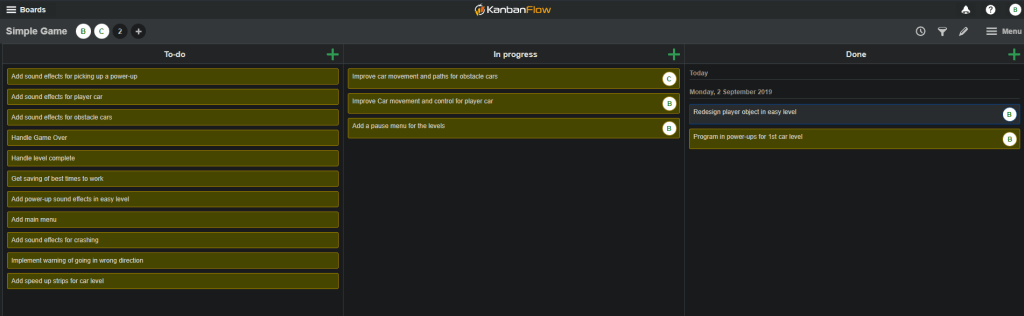
Now we’re moving away from tools that I actually use, and into a couple of “potential tools” that I either use for other types of projects, or don’t particularly use at all. The first of these two tools are: kanban boards! For those of you unfamiliar with kanban boards, they are a way for an individual or a group of people to organize and track the progress of tasks in a project.
Going back to my programming roots, I’ve included an image of a kanban board for a video game I was developing with a friend. This particular game was scrapped for another idea, but the remnants of the game’s progress remain. As you can see, our kanban board is divided into three columns: To-do, In Progress, and Done. When I would finish a task, I would move the card from the “In Progress” column to the “Done” column. I would then grab another task, assign it to myself, and move it to “In Progress.” Rinse and repeat.
While I don’t use kanban boards for writing projects (yet), I see the potential for them to be useful. One could breakdown the scenes they need to write for their story, and then use the kanban board to decide which scene to grab and work on next. The kanban board could even be used to help plot out the entire process for a writing project (from brainstorming to publishing). Or, it could be used to keep track of multiple writing projects so that a writer can track which projects are awaiting feedback from an editor, and which projects they currently need to be working on.
The specific website that you see in the picture is from kanbanflow.com. What you see in my image is the free version. With the free version, you’re able to have multiple boards, you can specify how many columns you want, and what the columns are (you don’t need to have the To-do, In Progress, and Done columns that I do). You are able to add people to work with you as see in my image. With the individual tickets, you’re also able to change the color of the card and provide labels as to what the different colors represent.
It’s certainly not a tool that everyone will find useful. However, after having used kanban boards for several years with programming, I’m tempted to try using them with my writing. Because of that, I wanted to share kanban boards with all of you!
Social Media (WordPress excluded)
Finally, the last tool to mention is one which I’m sure that everyone is familiar with, and that is social media! Now one could argue that WordPress is a form of social media, and I certainly wouldn’t disagree with that. What I am talking about though is more of the Twitters and Facebooks and Instagrams of the social media sphere. Places where users can quickly interact with each other in short bursts, and maybe reach hundreds or thousands of people (if they’re lucky).
I grew up without the internet for much of my life. In fact, I didn’t have consistent internet access until I attended college. As a result, I missed the whole social media train. Twitter, Facebook, and all the others, I never put together any meaningful accounts with any of them. I have a Twitter account where I follow a couple of people, but I can count on one hand the number of times I’ve actually posted anything. Not to mention, the number of times I actually visit the account in a year I can also count on one hand (maybe two).
I do generally find myself better off not being on social media as there is a lot of unscrupulous characters on there. Every so often I’ll see a commentator on Youtube or the news discussing what Twitter is crying over or raging over on any given day. Fun! All that aside, there is great value for writers to be on social media.It provides easier access to their readers and other writers (probably editors and publishers as well). It gives writers a venue for promoting their newest works, and possibly helping get their foot in the door to things like writers’ groups.
Social media may be the type of tool I shy away from (apart from WordPress if you count it as such), at least for now. And it’s not so much of the darker side of social media, but more-so that I wouldn’t know what to do with it. If I created an account on a social media platform, I’d more than likely sink into oblivion with inactivity. Perhaps this is a tool for my future self to consider using, but for my present self, I think I’m good.
Closing the Toolbox
There are countless tools out there for writers to take advantage of. Many of the items I discussed here are available for free, or at least have free versions. The trick with picking tools worthy of one’s toolbox, is sifting past the trash to find the treasure. I’m not saying that the tools I’ve listed are perfect, or are even appropriate for everyone. As of right now, they’re exactly what I need to get my work done.
In time, when I look back upon this post, my tool-set may evolve to the point where this list changes completely. Or, there may be only tweaks. Whatever the case is, I hope I’ve provided some useful resources for you to use with your own writing. I’d be curious to hear of any tools that you use that are not on this list. Or do you already use some of them? And if you don’t, will you start experimenting? I’m curious to find out!
What am I doing? What is going on? Typing out a blog post shouldn’t be this difficult, yet here I am, mulling over my introduction while those questions swirl around in my head. And as for the title, it’s more directed at me than anyone else. Although, now that I think about it, it’s a great phrase to get accustomed to saying. Whether you think the words being written are worth the ink in your pen or the bytes on your computer is irrelevant. What matters is that if you want to write, then you should write.
It’s a bit of a riff of the saying, “Just do it!” The problem with using that specific phrasing though, is that so few things in life can be done so easily. If someone points out that my shoelaces are untied, I can “just do it” and have them tied again. If I want to have a glass of chocolate milk, I can grab a glass, some milk, and some Nestle Nesquik and “just do it.” But, if I wanted to publish a book (a feat I’m currently working on), I cannot “just do it.” That is a whole process that requires large amounts of time, energy, and persistence. It’s a case of “easier said than done.”
The point is not to discourage, but rather to encourage. That’s why I feel that “just write” is a more actionable statement. We all can “just write.” Whether it’s my niece learning to write her name, or me, trudging through my pages of notes to write out a scene, we can all put pen to paper and scribble something down. And that’s where everything starts.
I’m currently in the midst of completing my first draft for a novel that has been swimming around in my head for years. What’s taken so long? Admittedly, some of it has been laziness. It’s far too easy to come home after work and just twiddle away the hours until bedtime. But eventually, the whispering in my head dialed up to a scream of “just write!” So I pulled out my keyboard, opened up my word processor, and started on my journey. There’s still a long way to go for sure, and plenty of opportunity for me to mess things up. But as long as I keep writing, I will move ever closer to my goal of publishing my first novel.
Learn From The Best
If you’re not sure where to start writing, there’s a couple avenues for you to explore. The first avenue is one I’m sure you’re familiar with. Reading. If you want to get good at a skill, one time proven tradition is to “learn from the best.” Since the odds of getting a personal tutor session from the likes of Amy Cross or Jayne Faith (two authors I’m currently exploring) is a certifiable zilch, the next best thing is to read their work(and by all means, study the authors that speak most to you).
Read to see: how they structure a narrative, where characters get their motivation, and how conflict progresses from chapter to chapter. Absorb yourself in the story and determine what makes their writing so compelling. What is it that draws you to their books? Is it the mix of fantasy with an urban setting like in Jayne’s Stone Blood series? Or is it the chills that keep you awake from reading Amy’s The Bride of Ashbyrn House?
Fan-Fiction Anyone?
Another avenue to explore, and this may be surprising, is fan-fiction. I spent over ten years of my life wandering in and out of writing fan-fiction. From anime characters to giant monsters and yes, even a few pony based tales, I would drown myself in the world of various shows and movies and take the characters on my own cocktail of adventures.
While there is a lot of negative stereotypes surrounding fan-fiction authors (such as “shipping” characters into contrived romance stories), starting out your writing career with fan-fiction may be just the open door you need. When it comes to writing a good story, there are three basic building blocks: setting, characters, and plot. Theme is also important, but my focus here is more-so on the basics.
With fan-fiction, you have two of those three building blocks already in place. You have the characters, and you have the setting. Now the setting can be malleable, and altered as the story requires it. The characters though, they already have their own unique voices and personalities. For me I found it easy to write for characters where I could easily hear their voices in my head, speaking the dialogue for a given scene. Over time, I could also predict their motivations and actions based on a situation I placed them in.
While not appropriate for all writers, I think fan-fiction is a great place to get your feet wet with writing. You get to explore characters and plots you’re already interested in, without having to build everything up from scratch. With an existing foundation, you can tell all kinds of stories, not to mention read countless others to see how the same characters are portrayed. Of course, fan-fiction has a wide range in its quality, which is something to be mindful of. But when used as a stepping stone, I think it provides a wealth of benefits to aspiring writers.
To Infinity, And Beyond!
The final avenue I’ll mention is “exploration.” While I’m sure there are many different routes that I have not even thought of, I think this is probably the best route for a writer. What do I mean by “exploration?” Try writing in different genres, or in different points of view. Try using different formats and seeing what kinds of stories you can tell with them. For example, in my fan-fiction days, I wrote horror, romance, attempted some comedy, and then one exhausting fantasy epic that took a good two years to complete. I’d write in third person for some, and first person for others. And in one particular short story, I used a series of letters from one character to tell the story of a dying farm and an old grandma checking in on her granddaughter who’d moved away. It’s a story that while few read, was more about the experience for me as a writer.
For you, this may mean taking a swing at some poetry, or even writing out a screenplay. You might challenge yourself to a 100 word limit piece, or write in that one genre you know absolutely nothing about (just to see what would happen). With writing, there truly is no limit as to the stories that can emerge. All it takes is a voice in the back of your head to whisper, “just write” and you’ll be off on an unforgettable adventure where the price of admission is nothing more than a pen and a piece of paper.




 Brian The Wanderer